













Foam Board vs PVC vs Aluminum Signs: Which Rigid Sign to Choose
Choose by where the sign lives and for how long: foam board for indoors or under cover for a day (easel and event signs), PVC board for indoors and sheltered outdoor spots for years (lobby, menu and door signs), and aluminum for signs in sun, rain and snow for years (real estate, parking and job-site signs).
Published 20 Oct 2026 by the Vorex Printing team
The short answer
Pick the board by where the sign lives and for how long. Foam board is for indoors or under cover for a day: easel signs, event boards and presentations. PVC board is for indoors and sheltered outdoor spots for years: lobby signs, menu boards, door and directional signs, a sign under a porch roof. Aluminum is for signs that face sun, rain and snow for years: real estate posts, parking and property signs, job sites and storefronts. All three are printed in full colour, single or double sided, and get a digital proof at final size before printing.
Side by side
| Foam board | PVC board | Aluminum | |
|---|---|---|---|
| What it is | Polystyrene foam core between two smooth faces | Expanded (foamed) PVC sheet with a smooth skin on both faces | Solid aluminum sheet; aluminum composite (ACM) on request |
| Usual thickness | 3/16 in (about 5 mm); 3 mm and PVC-faced board on request | 3 mm for most signs, 6 mm for larger or free-standing panels | 0.040 in for most signs, 0.080 in for large panels or posts in wind |
| Where it belongs | Indoors, or under cover for a day | Indoors and sheltered outdoor spots | Outdoors for years |
| Weak spot | Moisture swells the faces, heat bows the board, a knock dents the foam | Long direct sun can yellow it and heat can soften it | Abrasive cleaners dull the print |
| Typical sizes | 11 x 17 to 36 x 48 in, cut to size within 48 x 96 in | 12 x 18 in up to a 4 x 8 ft sheet | 12 x 18 in up to a 4 x 8 ft sheet |
| How it mounts | Easel, shelf, hook-and-loop tabs or double-sided tape | Mounting tape, picture hooks, screws or standoffs, ceiling wire, slot base | Screws or bolts through drilled holes, sign frames, fence brackets, zip ties |
Sizes and thicknesses are the usual ones; your quote confirms the board available for your size.
1. Foam board: light, flat, for the event
Foam board is a sandwich of polystyrene foam between two smooth facing sheets, so a 24 x 36 in board weighs only a few ounces and stays flat. The artwork is printed directly on the face, or printed on photo paper and mounted to the board, then trimmed so the image can run to the edge. The matte face takes photographs and fine text well and avoids glare under event lighting and camera flash.
- Best for: easel signs at weddings and events, presentation and pitch boards, open house and welcome boards, photo enlargements and exhibits, trade-show and conference panels.
- Size: 24 x 36 in is the size most people ask for and fits a standard floor easel; 18 x 24 in suits a tabletop or a smaller easel; 36 x 48 in or larger is for a stage or a booth wall.
- Keep it dry: moisture swells the paper faces and heat bows the board, so it is not for a sunny window or a lawn. Carry it flat or in a sleeve: a corner knock dents the foam and does not come out.
A display that stays up for a season? Ask for PVC-faced foam board, which resists dents and wipes clean.

2. PVC board: the lobby and menu sign
Expanded PVC is a foamed plastic sheet with a closed, smooth skin on both faces. It is far lighter than metal yet holds a rigid, flat shape, and it is printed directly with UV-cured inks, so small text, photographs and logo detail print cleanly. That is why menu boards, price lists, lobby and reception signs, door signs and safety signs use it.
- Thickness: 3 mm for wall, frame and easel signs up to about 24 x 36 in; 6 mm for larger panels, counter displays and signs that are handled often, because the thicker board resists bowing.
- Shapes: the board is contour cut to the outline of your artwork, such as an arrow, a logo or a number.
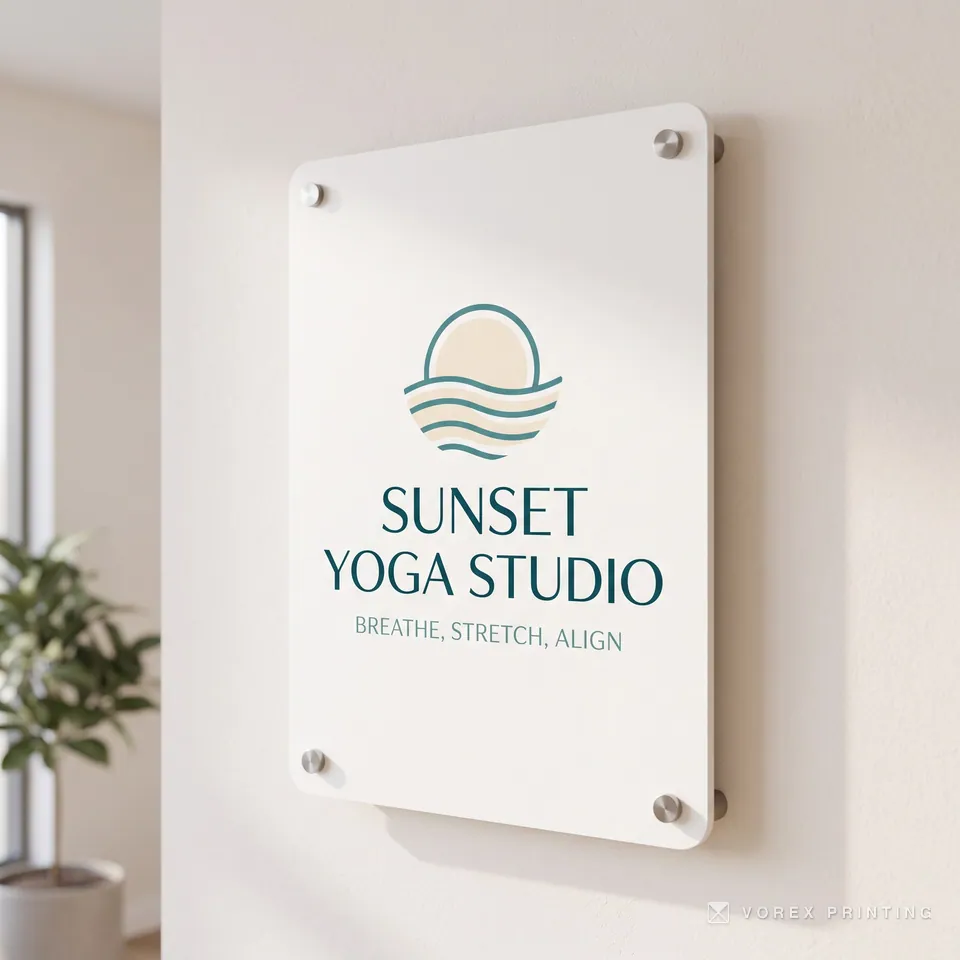
- Mounting: light enough for foam mounting tape or picture hooks, stiff enough for screws or standoffs that hold it off the wall for a finished reception look. Double-sided panels hang from a ceiling on wire or sit in a slot base on a counter.
- Outdoors: PVC does not absorb water, so it is fine under an awning, in an entryway or on a covered patio. Years of direct sun can yellow and soften it, so a sign in full weather should be aluminum.
A matte or gloss laminate adds scratch protection where people brush past the sign and makes a menu board easier to wipe down.
3. Aluminum: the sign that stays outside
Aluminum does not rust, rot or warp, so the panel outlasts the print on it. The artwork goes directly onto the panel with UV-cured inks, or is printed on adhesive vinyl, laminated and applied to the sheet. Rounded corners and mounting holes are cut before printing, so the sign arrives ready to hang.
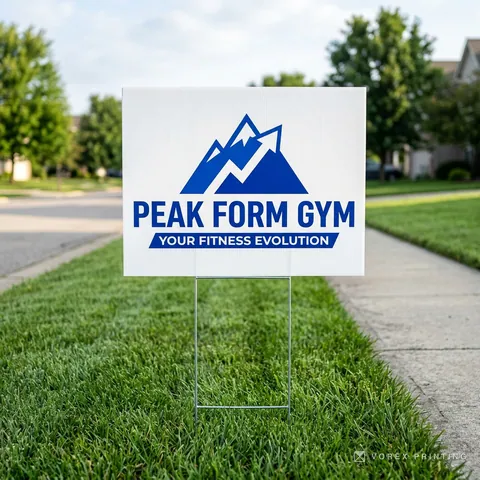
- Best for: real estate post signs, parking and property signs, job-site and project signs, storefront and building signs, wayfinding, farm and ranch gate signs.
- Size by reading distance: 18 x 24 in reads from a sidewalk or a driveway; 24 x 36 in or larger suits a parking lot or a road.
- Thickness: 0.040 in for signs in a frame, on a wall or on a fence; 0.080 in or an aluminum composite panel for larger signs or signs on posts in wind.
- Mounting: screws, bolts or zip ties through drilled holes, a real estate sign frame, or brackets on a fence or post. Use coated or stainless screws so nothing rusts onto the face, and leave a small gap behind the sign so water runs off.
For a sign in direct sun all day, add a clear laminate for scratch and UV protection; a matte laminate cuts glare on signs read from a road. Clean it with water and a soft cloth.
4. Three quick ways to decide
- Will it get wet or sit in sun? No: foam board or PVC. Under a roof: PVC. In the weather: aluminum.
- How long must it last? One event or a season indoors: foam board. Years indoors or sheltered: PVC. Years outside: aluminum.
- How will it hang? On an easel: foam board. On a wall with standoffs, from a ceiling or in a counter base: PVC. On a post, a fence or a sign frame: aluminum.
Checklist before you order
- Where the sign goes: indoors, under cover or in the open.
- How long it needs to last.
- The size, and single or double sided.
- How it mounts: easel, wall, ceiling, post, fence or frame, and any hardware you already own.
- Your artwork as vector or high-resolution files.
Not sure which board? Tell us the location on the quote form and the quote suggests the material, with delivery anywhere in the USA. Every sign gets a digital proof at final size before printing.
Read next: A-Frame Signs: Frames, Insert Sizes and Where to Put Them and Vinyl vs Mesh Banners: Which One Do You Need?.
Which is better for outdoor signs, PVC or aluminum?
Can foam board signs go outside?
What thickness should a PVC sign be?
What thickness should an aluminum sign be?
What size foam board fits an easel?
Can all three be printed on both sides?
Ready to see your design printed big?
Send us the size and quantity. We reply with pricing, material options and a digital proof of your artwork.
